The Sleep of Reason
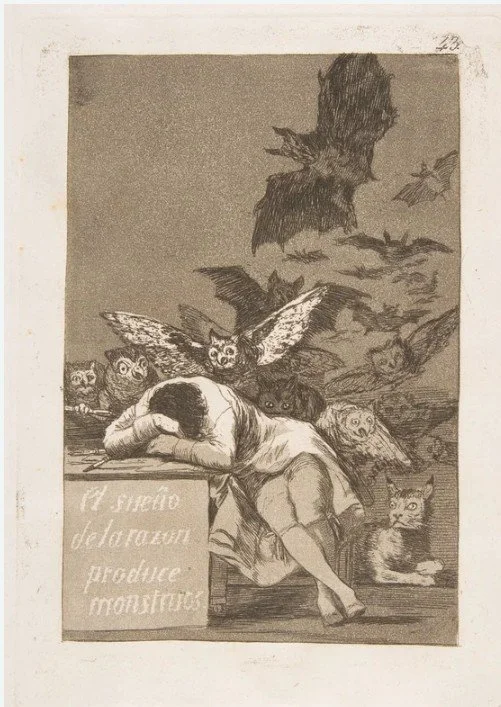
Thirty percent of my stories come from dreams. I go to sleep, enjoy some technicolor experience for eight hours, then wake up and write it down, sometimes verbatim.
In my book “A/not A” I spend two whole chapters describing and interpreting my dreams. I suggest that my dreams are the basis for the “abstract Surrealist” writing style I employ in some of my writing, but that’s not strictly true. The Venn diagram between my abstract stories and my story/dreams is an imprecise one - some of my story/dreams are quite sensible, and some of my stranger stories (such as “Mothman Revision”) came fully from my waking mind.
A tighter correlation can be drawn between sleeping and problem-solving. (Much to Kevin Ashton’s consternation) I do some of much of my best problem-solving when I am asleep, while my subconscious mind is unfettered with all the rational reasons why solutions “cannot” work.
This happened to me last night; so I am writing this blog.
The “Time ______ Dude”
In my dream I was considering how language transcribed the seat of conscious thought. I go over this argument in A/not A as well, describing how inner dialogue and experience (perception) gets translated to outer dialogue (language) at the moment of regard and consideration. In other words, as thoughts become rational they becomes “thoughts.” Previous to this, in their raw form, they are not rational; dreams may follow no rational order or structure, yet when we describe them to another they take on a rational (linguistic) form. The same is true of perception; regard of a rose (“It is a rose.”) gives it a rational (linguistic) order. Yet the raw experience is neither rational nor linguistic; it simply “is.”
While my sleeping mind considered this, a phrase of three words came into my mind: “The Time _____ Dude.” It consisted of three words, but only two of the words could be experienced or related. The center word, shown as a blank here, was either non-translatable (When I described the dream or regarded it in my conscious mind, it was blank.), or it was not blank but non-obtainable even to my sleeping mind; I could never determine which. All I knew was that the word was the member of a finite set with distinct properties - I knew it must rhyme with both “Time” and “Dude” (a rational impossibility; there are no words which rhyme with both these words) because it was part of a tripled couplet. The solution set could be described as a Venn diagram of all words rhyming perfectly with “Time” intersecting with all words rhyming perfectly with “Dude.” (An empty set in the intersection.)
The two words in the superior set could be exchanged for others, but the left set must consist of an object (such as “universe,” “falcon,” or “nebula”) and the right set be an observer of that object. Thus is the dream’s example, the “dude” is an observer of “time.”
The dream seemed to last only two or three seconds. Upon waking, I was left to interpret it, in accordance with what I knew of consciousness theory and language.
A Thrust Towards Understanding?
I have a habit (I suppose) of writing about things no one else cares about. The last two months, I have been IMMERSED in this since I am producing a THIRD EDITION of A/not A. (One would have thought two editions were more than enough.) Naturally, I interpret the dream in the context of this book.
The OBJECT (“Time”) represents the PHYSICAL UNIVERSE, which I spend a lot of effort denying existence. I am essentially a Hegelian epistomologician, for whom nothing remains demonstrable besides perception. The SUBJECT (“Dude”) is of course the observer, and since the two outer terms are transcribed in language they are not an immediate event but a memory, such as the Dude thinking back, “I observed time.”
The reversal of standard order (Object-Subject rather than Subject-Object) may indicate passive voice (Time was observed by the Dude) or more likely interchangeability of the Object and Subject in a quantum framework: Time does “something” to the “Dude” as the “Dude” does something to “Time.” This is of course a description of entanglement, and the key role of an observer in the outcome of an experiment.
But why is the middle term (the intersection) unknown? My immediate impression upon awaking was that any term could stand here; It was like an algebraic formula (“x + 2y = 0”) where we must solve for the missing variables. The only properties given (that the middle term must rhyme with the two outer terms) shows the formula has no known solution.
Neuro-Linguistic Programming and Hilbert Spaces
The model of Hilbert spaces seems closely aligned to the model exposed in the dream. In it, Syntactic, Semantic, and Pragmatic/Contextual sets interact cross-sectionally to arrive at quantum superposition. (H = H (syn) X H (sem) X H (ctx)) The tensor product so derived is the language model in multiple dimensions. “Time” and “Dude” exist within the noun space, and the missing middle term represents the entanglement, such that if either term becomes altered it alters the whole structure. Consider:
Dude observers Time
vs.
Dude doesn’t observe Void
These terms are determinate within the tensor space; therefore an indeterminate middle term is not a holistic description of Hilbert spaces made up of real vectors, since a mathematical model with an indeterminate term has an indeterminate solution.
Furthermore, by mapping tensor sets to four Cartesian coordinates (A and B; A and Not B; Not A and B; Not A and Not B), the description of NLP coaching sets again seems determinate instead of non-deterministic. It seems based upon classic logic and not quantum principles.
In short, if the subconscious mind mapped sets in multiple dimensions and eliminating possibilities to assign truth value before achieving one simple linguistic construct, this would INCREASE the amount of work involved. We would not see the sudden burst of inspiration, but a pondering grind more like a brute force model. NLP might be an adequate tool for mapping out “logical” courses of thought, but it doesn’t describe how the mind actually works.
The A-Ha Moment and Non-Local Sets
An indeterminate middle term is less of a problem in quantum mechanics than it is classic mathematics. It seems like this is simply a description of the wave function: If “words” are particles, then a middle term which contains all possible terms is an uncollapsed wave.
The amplitude of this wave function is found by finding the product of the real vectors of each possibility within a Banach space. In other words, there are some words which satisfy the condition of the expression (“Time _____ Dude”) and others which do not. The topology extends to the whole of the inner set; it may also extend to a non-homeomorphic topology (the “not A” to “A”) which corresponds to the four logical sets of NLP. These are called “Non-Local Sets,” since they correspond to other observers’ possibilities.
The “A-Ha” moment I speak of with such certainty in A/not A is the COLLAPSE of the wave function; when the mind disassociates all but correlating vectors within the Banach space. This collapse of the wave function is not discussed in QNLP models, which therefore describe linguistics and not thought. The only reason these systems (QNLP) are “quantum” is that they map multi-dimensional structures within one language model.
I thought (for a brief, giddy moment) that the indeterminate middle term of the expression WAS the “Divine Definition” (spoken of in A/not A); I mean, it could be “anything”; you could stick “anything” in there and the expression would still be valid. Surely, you could define “anything” from this one term. Unfortunately, once I lightly researched it, I found it was not, because even adding non-local sets did not expose a boundless topology. (To put this into layman’s terms) It might be possible to “think any thought” but all this is bound by existing structure of thought. The “divine definition” may not exist unless we can arrive at a boundless topology from a limited set of coordinates.
What Does This Mean?
I’ve been working way too hard on A/not A, creating a manual index, which is unmitigated H-E-L-L. I think I may have broken my mind, so it weeps openly when I sleep without the protection of the Eye of Agamotto. (This is NOT the “sleep of reason.” It is not reasonable at all.)
I really should have studied calculus in college. It may help me sound less of an idiot while trying to bore and confuse my readers.
Yes, I actually do think of things that no one else cares about.